Alone together forever with the narcissistic?

Tokyo from the Skytree

There is something not quite right about the whole selfies thing. I can’t quite put my finger on it but I think it unlocks something much deeper and more troubling…

Its all about me

The selfie thing, I do find it self indulgent and dare I say it – slightly narcissistic in nature.

Narcissism is the pursuit of gratification from vanity or egotistic admiration of one’s own attributes. The term originated from the Greek mythology, where the young Narcissus fell in love with his own image reflected in a pool of water.

Maybe instead of a pool of water, its a reflection of yourself in a 533 DPI mobile screen?Ā  I don’t think everyone who does a selfie are inherently doing it for narcissistic reasons. Let me be clear about that. But there is something not quite right about seeing friends Selfies all over my facebook timeline of nothing more than people trying to style things out in front of a mirror. Then you get the likes or +1’s.Ā  Finally you got the millions of selfie sticks being sold and used by people who should know better… its enough toĀ  makes you wonder, right?

While in Tokyo, I saw a lot of selfie sticks and lots of people using them. There use seem to go from a picture with friends to a slightly more worrying shot after shot after shot of them self till they got the right one to share. One guy must have taken about 30 pictures before he was happy with one of them. I know because I was watching him on his super bright iPhone 6Ā  plus.

Its about you… alone

As you can imagine I’m not the only one thinking this.

What greater testament could there be to the “me generation” than the rise and rise of the selfie? Anointed by Oxford Dictionaries’ editors as the word of the year after a 17,000% increase in its usage, the selfie is surely the ultimate emblem of the age of narcissism.

One of the names I’m most unlikely to align with is Andrew Keen. I have slammed Andrew in the past for his views on the internet. But it kills me to say, he makes some good points onĀ  Twit.tv’s Triangulation 183. I’m sure his new book will still have me and many others shaking our heads, I haven’t read his book and are unlikely to buy it to be honest but he’s spot on about the use of algorithms and the selfie thing.

Tokyo from up high

While on my trip to Tokyo I took a few selfies. I never quite feel good about it, my face generally describe how I felt about the whole thing. I also started to wonder if the break down in our social humanity (if people like sherry turkle are correct) can be seen ahead of time in Tokyo?

Japan is always known as way ahead of the curve. When most of us were still using desktops and laptops to connect the internet, residents of Japan were using their phones. Theres many other examples but I spotted something which deeply worries me. Sherry Turkle’s connected alone was playing out everywhere you went.

Selfie Sticks

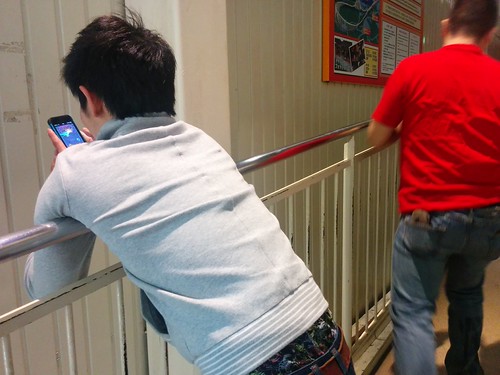
I was in the queue for a rollercoaster and 4 guys were standing in silence through out the whole 40-50min queue. There were each transfixed to their phones not uttering a single word till we finally got on the ride and then they were best buds, laughing and chatting away. I saw them again later (the theme park wasn’t that busy and isn’t that big – about the size of Thorpe Park) and it was more of the same.Ā  They may have been playing the same game but together they were alone.
Alone together

Sad as it may be (you could say its part of the Japanese culture, but I’m not so sure), you are seeing more and more of this. And its not just a age thing. The online world can be very seductive and some people forget the offline world for many reasons. Maybe things are difficult there, things are not going so well, they can be somebody else? Theres a load of reasons.

Two pieces I have saved in my instapaper, really got me going…

One is via Tony Churnside10 Reasons Why This Generation Is Losing The Ability To Be In Love.

Every individual in the world is egocentric; we all think about our needs and ourselves first and foremost. Whether this is good or bad doesn’t really matter; the world is the way it is. It’s part of human nature.The problem arises when our egocentricity overtakes our ability to feel empathy. As human beings, we have no choice but to live and function within society, within communities of different sizes.

And I found the next one while following links on a site called Thought catalogueThis is the new loneliness

Our generation of sadness and loneliness is of the unchecked variety. Of wallowing. Of letting ourselves be disconnected from both others and ourselves. Learning to soothe more than heal. Learning to put a band-aid on problems instead of working through and solving our problems. If something is not immediate, we don’t want it, even if it’ll make us stronger. We’re not growing as people, not really. We’re shoving away ā€œbad feelingsā€ we don’t want to face by clicking, refreshing, scrolling until we’ve numbed ourselves out enough. It’s addiction.

We cut ourselves off from others, avoiding contact with outsiders. How scared are we? That we are not willing to hand over our camera and talk to (maybe) a familiar stranger?Ā  Who knows what fruitful conversations may spring up because of that moment/encounter/opportunity? But we will never know because we are too focused on our virtual selves.

Sherry Turkle and Andrew Keen could have wrote either and I would somewhat believe it was them.

Akihabara, Tokyo

Virtual friends and likes

This should go without saying because there has been so much said about virtual friends, buddy lists, likes, +1’s, follower counts,Ā  etc. And this is also where the difference between Narcissism (the pursuit of gratification from vanity or egotistic admiration of one’s own attributes) and Egocentrism (the inability to differentiate between self and other).

I use narcissism because I feel it requires other people to breed as such. Its also something we shouldn’t be heading towards. I can deal with a room of egocentric people for a short while, but a room of narcissists is deeply worrying.

Its all pretty troubling but I have hope for humanity. I feel like its a craze right now. The market can sell more goods you don’t actually need. The drive has always been to make us feel less empowered and cut us off from each other. A disfranchised citizen makes a good consumer?Ā  Retreating to the wall gardens of the 5 stacks.

My hope is we will have more which saddle between the real and virtual worlds and operate in a open fashion. I believe the user interfaces we build, shapes our use and therefore it shapes us – ontological design. From the Cluetrain

#79 –Ā  We want you to drop your trip, come out of your neurotic self-involvement, join the party.

Warning!

This was written and scheduled during a 17 hour flight with very little actual sleep (trying to adjust to GMT as soon as I get off the plane). I’m very tired and I am likely to be connecting things in a very weird way (not like that never happens eh?). But I do feel like there is a link and worth posting…

35° 29.155 N 138° 46.729 E

Alternative user interfaces

I studied interaction design in university and always had an imprecation for good interaction and interface design. Recently I seen a few examples which have got me a little excited.

Ubuntu’s scopes
I like ubuntu’s unity paradigms of scopes and lens, even though I prefer to use Gnome Shell as my default on the desktop. The scopes and lens really make a lot of sense. It was fascinating to see Ubuntu apply it across their phone and tablet. Be interesting to see how it works on Ubuntu TV if thats still ongoing?

Pebble timeline
When I first saw the pebble time interface, I instantly thought, when are they going to roll that across there existing line of smartwatches? If not, maybe I might invest in one of the new ones. Division of a interface by future, present and the past on a watch makes a lot more sense than anything else I have seen to date including the Apple Watch.

Android Material Design
Ice cream sandwich or Android 4.0 was a massive step up in style for Android but Android 5.0 Lollipop really was the first Android when the interaction design was thought about at a deeper level.

I don’t necessarilyĀ  like the style of flat plates of colour for example the Google hangout app is just the wrong kind of green for my pallet but the interaction model is nice. Although I have spotted a few places where the rules are broken by certain apps.

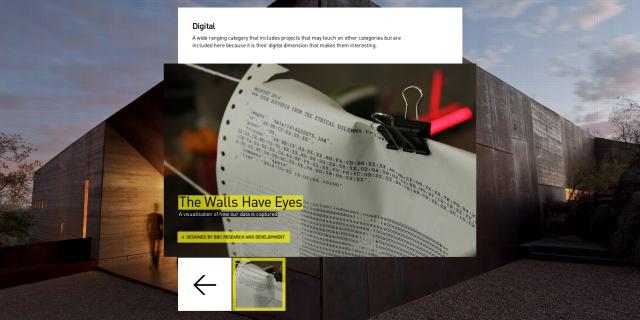
The walls eyes up a design award

BBCRD up for a design award

So happy for Libby, Andrew and Jasmine who worked on the Walls have eyes exhibition within the ethical dilemma cafe at Mozilla Fest last year. Its been a bit of a secret but now its been announced along with the other digital entries.

Mozfest 2014

Knock them over guys! It was a great idea and the images were so great. So happy to have given you guys the space to run it and frankly make us think about the ethics of our personal data some more.

Interestingly while thinking about the ethics of personal data, Doc Searls and David Weinburger recently kindly took time out of their busy schedule to talk about the Cluetrain and NewClues at Commonground. Doc said something which got people going a little

..what seems to have struck the Chord of Controversy was something I blabbed:Ā ā€œTracking-based advertising is creepy and wrong… and needs to be wiped out.ā€Ā Martin Bryant (@MartinSFP)tweeted a video clip and a series of other tweets followed.

Being tracked around spaces is something we did within the ethical dilemma cafe and its a mistake to think others are not doing this already.

The dilemma is what are you going to do? And I’d love to see a proper public debate about this all. Maybe this could be arranged following some of the work I’m about to release…


Dropbox as furniture design company

This Alabamiana Library Is A Beaut

Dropbox as furniture design company” – @iledigital (Jon Rogers)

When Jon first said this to me, I had to think for a second. Then I got it.

Amazon, ibooks, etc all have their own proprietary ways of holding your ebook. But imagine if youĀ  used many different sources to gather books and organise them. Some digital and some physical (like I do) These are sync’ed using Dropbox or other syncing systems and instead of being displayed as files, appear like dropbox’s photos stream. A far more useful way to display books you have and heck why not make it sharable while your at it?

Next leap… Instead of it being just a digital thing, how about as a physical manifestation? Dropbox could sync the physical and digital together, like a wispersync for binding digital and physical items. Maybe it slots a bookmark into position or folds over the top edge of a page?

But one thing you don’t want is some ugly as sin apple skeuomorphism bookshelf in your living room. It would need to fit with the rest of the furniture and surrounds. Making Dropbox a furniture design company. Not such a massive leap in imagination I would say…

Apple have lost the plot

iPad 2 as a Video Camera

I have been meaning to write about those disgusting Apple adverts (yes disgusting, I was almost sick in my mouth when I first saw it) but been so busy, then Maggie reminded me at Hacked.io about what I wanted to say.

Fast Design write up pretty much how I feel

Watch the ad closely for me. As we’re told that products are what matter, we see a series of shots in which people actively turn away from life to engage with their technology.

  • A woman closes her eyes on the subway to soak in electronic music.
  • A room of students looks down at their desks instead of at their teacher.
  • A parent and child cuddle, focused on a screen that’s so powerful it illuminates the kid’s face.
  • A couple kisses in the rain, then immediately turn away to look at a phone.
  • A tourist opts to FaceTime instead of bathing in visceral, smoky yakitori.

In what should be a warm, humanizing montage, people are constantly directing their attention away from one another and the real, panoramic world to soak in pixels. They’re choosing the experience of their products over the experience of other people several times in quick succession. And Apple has a warm voice in the background, goading us on.

Now I’m fully aware most adverts are like this but frankly for Apple, this is bad bad news.

On top of that, the fact Apple are advertising this factor, is worst still. So much for creativity…!

Just to be clear the best adverts in this class were the Orange adverts, which never showed the actual device but rather the effect of the device. Now unfortunately Orange or rather EE have switched to another style which isn’t much better than most.

The technology should be the glue not the end point. However Apple want you to marvel at there devices. I’m not certain when this changed but its certainly changed for the worst.

Have to be clear I’m not against devices, heck if you follow this down the line you can end up somewhere with Sherry Turkle.

Our devices and software are great but I have to echo some of the thoughts about using your mobile while dating and dare I say it, some of the Orange Cinema adverts. Don’t let your device get in the way of a great time. No matter how pretty it maybe.

Its not going to take 20 years… Its outdated and shockingly backwards already…

User experience design with Aral

Safety dip

Before I start on this little rant, its worth pointing out this is following a talk from Aral Balkan’s talk at Thinking Digital 2013. I have still yet to write my review of the best talks and my own experience with Perceptive Radio but I had to stop and moan about Aral’s talk.

Aral is a friend and I like him a lot but even in the early days I disagreed with him on so many things.

Aral showed many examples of really bad user experience design, many where they got the focus wrong.

User experience bugs me, I agree with a lot but then there are many examples where it seems like a simple no brainier. I would generalise what Aral was showing but I lost my notes by accident in the wifi handover (hoping there still on my tablet and just need to load up evernote and sync the notes. So as I was saying user experience is important but they sometimes go too far…

Here’s something I tweeted last year…

“Frankly this is the worst keypad layout I’ve seen in the wild. #Metrolink should be a shamed of this! http://yfrog.com/odgevclj”

Aral spoke about washing machines and how complex they are. He suggested all you need is a some places to put the washing powder and fabric conditioner. A button or two to maybe start a programme and thats it. Well no I disagree. My mum is a genius with the washing machine and she knows exactly what to put in for the weight and volume of clothes. To be such a expert required time and effort, shes proud than shes mastered the washing machine.

Having a single button machine would rob my mother of her mastery of that machine.

Now I imagine Aral would say, for the bulk of people, all they want to do is get there clothes clean and they don’t really care. And he would be right. I generally don’t care but robbing people of the ability to master a system or device seems a real shame and I’d say is criminal.

After Arals talk and a slight break for audience clapping. He launched into how he’s been involved in helping the next generation to learn how to get their digital skills. How ironic that most of us got our start by mastering the computer by ultimately being geeky.

If you subscribe to the idea that we are almost all geeky about something (coding, design, cars, cooking, paintings, trains, stamps, celebrities, tv shows, beer, phones, films, cocktails, gardening, farming, sports, etc). Most of these require experience, understanding and mastery. Robbing someone of this seems at least to me anti-human.

Not that I’m saying you should have to go through an ordeal to get a ticket for the train/metro/tram. The example of the CTA machine is a total joke, I remember looking at it when I last was last in Chicago and thought what level of hell does this machine come from?

Heat control

I would say the showers in most modern hotels is up as a example of a great user experience because they have that recommended option but if you know better you can press the button and get even more heat. Yes the button protects you from burning but it can also be easily bypassed. Now thats my kind of user experience.

Aral mentioned a few other things which had my fingers tapping.

“Design can not be democratic, design is opinionated and full of assumptions.”

Design can not be democratic? I say rubbish, designers work in small groups and collaborate on problems all the time. I would go as far as to say design in isolation is art. Design doesn’t have to be opinionated, in actual fact user experience design is about designing around the accordances of the user. This means working around them and not making assumptions…

Anyway everything I’ve said is just my view and I’m sure I would say the same to Aral’s face. Looking forward to next time we meet and of course šŸ™‚ Which will be soon… Good talk even though I was screaming inside šŸ™‚

Context is queen?

I wanted my grandmothers pokerface....

I’m hearing a lot of talk about how 2013 is The year responsive design starts to get weird… or rather how its going to be all about responsive design (what happened to adaptive designing who knows)

Think it’s hard to adapt your content to mobile, tablet, and desktop? Just wait until you have to ask how this will also look on the smart TV. Or the refrigerator door. Or on the bathroom mirror.

Or on a user’s eye.

They’re all coming…if they aren’t already here. It doesn’t take much imagination or deep reading of the tech press to know that in 2013 more and more devices will connect to the internet and become another way for people to consume internets.

We’ll see the first versions of Google’s Project Glass in 2013. A set of smart glasses will put the internet on a user’s eyes for the first time. Reaction to early sneak peeks is a mix of mockery and amazement, mostly depending on your propensity for tech lust. We don’t know much about them, other than some tantalizing video, but Google is making them, so it’s a safe bet that Chrome For Your Eyes will be in there. And that means some news organization in 2013 is going to ask: ā€œHow does this look jammed right into a user’s eyeballs?ā€

Stop! Nieman labs is forgetting something major! And I could argue they are still thinking in a publishing/broadcasting mindset

Yes the C word, Context…

Ironically this is something Robert Scoble actually gets in his blog post,Ā The coming automatic, freaky, contextual world and why we’re writing a book about it.

A TV guide that shows you stuff to watch. Automatically. Based on who you are. A contextual system that watches Gmail and Google Calendar and tells you stuff that it learns. A photo app that sends photos to each other automatically if you photograph them together. And then there’s the Google Glasses (AKA Project Glass) that will tell you stuff about your world before you knew you needed to know. There is a new toy coming this Christmas that will entertain your kids and change depending on the context they are in (it will know it’s a rainy day, for instance, and will change their behavior accordingly)

Context is whats missing and in the mindset of pushing content around (broadcast and publishing) and into peoples faces, responsive design sounds like a good idea. Soon as you add context to the mix, it doesn’t sound so great. Actually it sounds damm right annoying or even intrusive? I do understand its the best we got right now, but as sensors become more common, we’ll finally be able to understand context and hopefully be able to build perceptive systems.

We already demonstrated, sensors don’t have to be cameras, gyroscopes, etc. The referral, operating system, screen resolution, cookies, etc all are bits of data which can (some maybe less that others) be used to understand the context.

I can come up with many scenarios where the responsive part gets in the way, unless you are also considering the context. In a few years time, we’ll look back at this period of time and laugh, wondering what the heck were we thinking…

I’m with Scoble on this one… Context and Content are the Queen and King.

The power of narrative

Children at First Lubuto Library

While working on Perceptive Media, I came across many examples of narrative and the power of storytelling. Something which I’ve been trying to demonstrate in my presentations pointing at how little subtle things can have huge effects. Recently I saw this which reminded me I haven’t posted anything about it recently

Telling stories is not just the oldest form of entertainment, it’s the highest form of consciousness. The need for narrative is embedded deep in our brains. Increasingly, success in the information age demands that we harness the hidden power of stories…

…in four decades in the movie business, I’ve come to see that stories are not only for the big screen, Shakespearean plays, and John Grisham novels. I’ve come to see that they are far more than entertainment. They are the most effective form of human communication, more powerful than any other way of packaging information. And telling purposeful stories is certainly the most efficient means of persuasion in everyday life, the most effective way of translating ideas into action, whether you’re green-lighting a $90 million film project, motivating employees to meet an important deadline, or getting your kids through a crisis.

When I was training to be a designer, it was drummed in to our brains that you need to have a story to explain the product, service, etc… Without that story or narrative your on a loosing road. Not only that but you want to give them the least distractions as possible.

Stories, unlike straight-up information, can change our lives because they directly involve us, bringing us into the inner world of the protagonist. As I tell the students in one of my UCLA graduate courses, Navigating a Narrative World, without stories not only would we not likely have survived as a species, we couldn’t understand ourselves. They provoke our memory and give us the framework for much of our understanding. They also reflect the way the brain works. While we think of stories as fluff, accessories to information, something extraneous to real work, they turn out to be the cornerstone of consciousness.

Enough said… but if you do get the chance to read all 3 long pages, it will be worth it…

Creative people are the whores of capitalism?

POT POTW Challenge 20080202 - 20080208 (Creative) - #1

Herb tweeted this and I thought it was going to be a story like mine, but what I was surprised to find a critical look at the creative economy…

This has come as quite a shock I can tell you. I think, I’ve come to the conclusion that the whole thing was a bit of a con. A scam. An elaborate hoax.

The scam works like this:

1. The creative industry operates largely by holding ā€˜creative’ people ransom to their own self-image, precarious sense of self-worth, and fragile – if occasionally out of control ego. We tend to set ourselves impossibly high standards, and are invariably our own toughest critics. Satisfying our own lofty demands is usually a lot harder than appeasing any client, who in my experience tend to have disappointingly low expectations. Most artists and designers I know would rather work all night than turn in a sub-standard job. It is a universal truth that all artists think they a frauds and charlatans, and live in constant fear of being exposed. We believe by working harder than anyone else we can evaded detection. The bean-counters rumbled this centuries ago and have been profitably exploiting this weakness ever since. You don’t have to drive creative folk like most workers. They drive themselves. Just wind ā€˜em up and let ā€˜em go.

2. Truly creative people tend not to be motivated by money. That’s why so few of us have any. The riches we crave are acknowledgment and appreciation of the ideas that we have and the things that we make. A simple but sincere ā€œThat’s quite good.ā€ from someone who’s opinion we respect (usually a fellow artisan) is worth infinitely more than any pay-rise or bonus. Again, our industry masters cleverly exploit this insecurity and vanity by offering glamorous but worthless trinkets and elaborately staged award schemes to keep the artists focused and motivated. Like so many demented magpies we flock around the shiny things and would peck each others eyes out to have more than anyone else. Handing out the odd gold statuette is a whole lot cheaper than dishing out stock certificates or board seats.

3. The compulsion to create is unstoppable. It’s a need that has to be filled. I’ve barely ā€˜worked’ in any meaningful way for half a year, but every day I find myself driven to ā€˜make’ something. Take photographs. Draw. Write. Make bad music. It’s just an itch than needs to be scratched. Apart from the occasional severed ear or descent into fecal-eating dementia the creative impulse is mostly little more than a quaint eccentricity. But introduce this mostly benign neurosis into a commercial context.. well that way, my friends lies misery and madness.

It turned out to fit with my ex-boss’s idea of creative people being the whore’s of capitalism… (sure he came up with that). Its harsh and something I’d considered a while ago and I justify it by working for the BBC rather than some faceless entity…