When I read this article about the new breed of urban datasexuals I instantly thought maybe heck I might be one of them…?
The datasexual looks a lot like you and me, but what’s different is their preoccupation with personal data. They are relentlessly digital, they obsessively record everything about their personal lives, and they think that data is sexy. In fact, the bigger the data, the sexier it becomes. Their lives – from a data perspective, at least – are perfectly groomed.
Oh crap that sounds just like me… I find it very difficult to maintain things on paper and much prefer them in data because I can manage them much better. I assumed it was a dyslexia thing to be honest (it might still be).
The origin of the datasexual in all likelihood started with the humble infographic, which is a highly stylized and well-designed way to talk about all the data out there on Web. The infographic trend was followed by the data visualization trend, which made it even cooler to display data in innovative new ways. These data visualization tools eventually gave us cultural artifacts like Nicholas Felton’s annual Feltron Reports, which made the obsessive recording of everyday activities seem cool. From there, it was only a small evolutionary step to the whole quantified self (QS) movement, which promises “self knowledge through numbers.” QS proponents obsessively track every single bit of data about themselves throughout the day. The QS movement eventually led us to the embrace of data by consumer-facing companies Nike, who found a way for urban datasexuals to flaunt their obsessive data-grooming to the rest of us in a way that’s stylish and mod.
For me it stems back to my ideas of the information behind the graphics.
When I was in college, I got into XML because I loved the idea of creating graphics which are self describing and can alter depending on the data there based on. Hence my love of Scalable Vector Graphics (w3c’s SVG specification). I was also a major pusher of SVG at the BBC for graphics and informational graphics but at the time browser technology was way behind.
Maybe this also reflects why my love of the idea of online dating via numbers, maths, science also really intrigues me so deeply?
The link up between the Quantified Self, personal data and sharing is so tight and also asks many questions. Questions which the early adopters and hackers are answering for themselves right now.
I remember my previous manager Miles Metcalfe, talking about the intangible of the semantic web… Somethings can not be quantified, at least in the ways were going about it right now. I would agree but we’ll have a good old go trying to do so. And from doing so we’ll have lots of fun, its when it stops becoming fun is the problem…
I’ll say it now… Data is Sexy no two ways about it… but the term data sexual does worry me a little along with quite a few of the commenters. Its Data Love but under the understanding that not everything can be defined or captured yet.
Updated
After the debate on Techgrumps 60 yesterday (listen to the last 10mins to understand) with Tom Morris who compares Data sexuality to something else which is certainly not pretty or nice. But the point is taken, what has this got to do with sexuality? Spicing it up with sexuality just confuses the whole thing and maybe makes those who love data into something their not. Data love is much better as a overall idea.
For ages now I have been seeking a better way to do certain presentations. I tend to spend a lot of time in Inkscape mapping out ideas but I don’t really want to put slides on different layers.
I bought a copy of dan roam’s the back of a napkin a while ago and I’ve been influenced by the idea of using white boards, mood boards, etc to explain ideas. The problem is that once you put the effort in to putting down the idea on to the canvas, you then have to re-adapt it to a presentation with Open Office. Its why I kind of like the idea of the unlimited canvas.
Prezi was talked about and overused to death a while ago, now you hardly see it. I blogged about it a while ago and decided that there must be a better more open way to do the same.
I have been thinking maybe some enterprising group of people could take the SVG specification and build a tool which generates these exact same presentations. So first up you can use scripts on every element including the viewpoint attribute. There seems to be a load of things you can do with the Canvas coordinate system. SVG 1.1 has the ability to embed certain multimedia but SVG Foreign Object could be used to place a browser or a complete video within a SVG.
You could imagine a specially made tool which worked like Prezi but wouldn’t need to be propitery and locked in. They could even create and sell a player and editor backed with its online space, so the business model isn’t totally shattered. Even if a rival tried to create the same, OpenPrezi as I’m coining it would be first to the market and have a wealth of knowledge of what works and what doesn’t. Even a track record might go down well. So in my mind, there’s no way I will be using Prezi till its a lot more open. I’m sure even I could with a bit of time construct something using the SVG methods I mentioned. I’m not questioning the method or even the concept, it actually reminds me of mood boards. Its the implementation which winds me up.
Well my questions have been answered by some enterprising group of people.
Jessyink is the answer…
JessyInk, an open-source extension to the open-source SVG editor InkScape.
Perfect, so once I’ve created my master piece, its hopefully going to take a few more moments to turn it into something presentable. I’m not the only person to realise the power of this setup. Prezi vs JessyInk
The first time I heard about Prezi, I started looking for a possible equivalent in SVG, and I discovered that JessyInk was a pretty good candidate: it combines a Javascript library that deals with enabling simple navigation through a SVG document according to some conventions, with an extension to the fantastic InkScape SVG editor to make it possible to integrate effects, transitions and views from the editor itself.
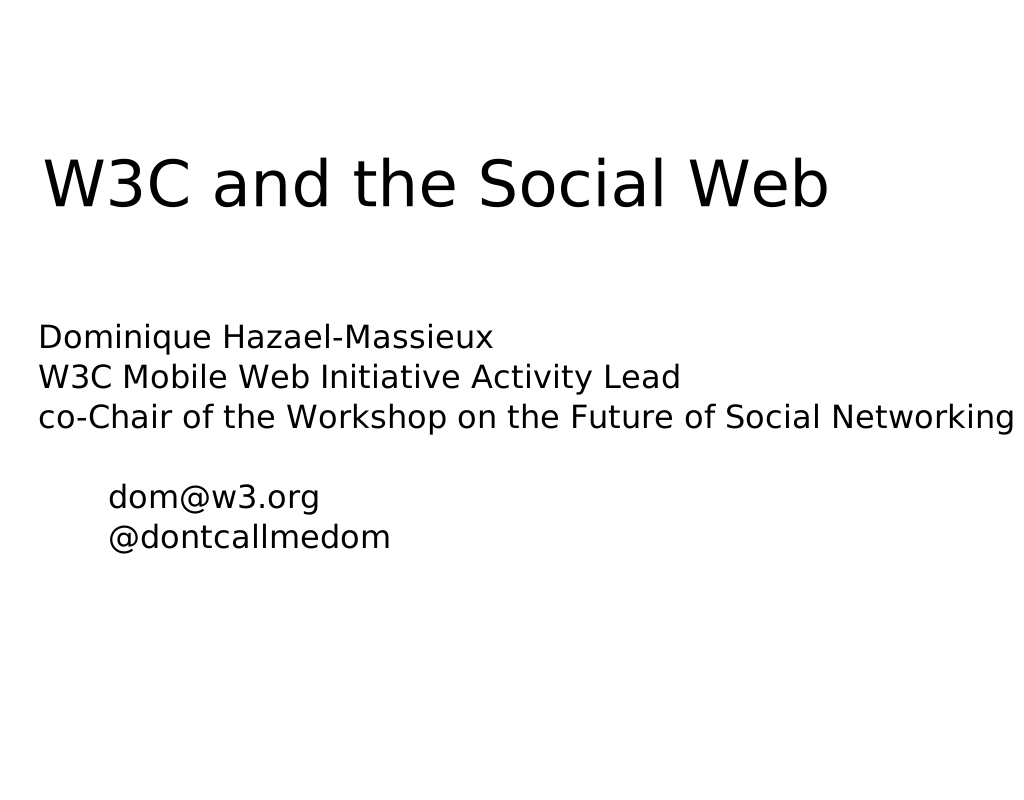
But it wasn’t until a few weeks ago that I got confirmation that JessyInk now provides the tools needed to build Prezi-like effects, and so, when I was invited to talk on “W3C and the Social Web” at the 10th anniversary of the W3C Italian office I decided to give it a try to build my presentation.
The resulting “slides” were OK, but they clearly remain much more “slide-based” than what I would have done with Prezi.
A big reason for that is that JessyInk still uses slide as the basic unit for its operations – slides are based on Inkscape layers across which you can have transitions. This doesn’t encourage working on a completely 2D-based presentation, even though it allows fairly easily to zoom in and out in a particular slide.
So it looks like JessyInk might have a bright future in front of it. The presentations are not quite as free flowing as Prezi, but to be fair its a good compromise. Open source comes up with the goods, and what a true test of the power of Open source! Fantastic, where do I start!
Brendan sent me this one last week, shocking news that Microsoft are joining the SVG working group. To be honest I never thought it would ever happen but hell has somewhat frozen over.
“Microsoft is joining the World Wide Web Consortium’s (W3C’s) Scalable Vector Graphics Working Group. The company announced its aim of improving future versions of the W3C’s scalable vector graphics (SVG) recommendation, currently at version 1.1. The nonprofit W3C’s SVG recommendation is a document that describes two-dimensional graphics processing using XML. The technology can be used for Web graphics, animation and user interfaces…
Lately, Microsoft has been leaning more toward standards compliance with its browser, especially with IE 8, which still lacks native SVG support. In particular, Microsoft contributed test cases to the W3C’s working group on cascading style sheets as it developed IE 8. In a statement, Microsoft suggested it plans to do more such work with the W3C: ‘Making the Web easier for developers continues to be important and we will continue to contribute to development of HTML5, along with other popular Web standards; and we bring a unique value—the rigor of modern software engineering to the process.
I am getting a little worried about SVG, as a lot of people are pushing not just Flash but VML and Canvas in front of SVG. Its incredible how little people know about SVG and vector graphics full stop.

I have finally finished the logos for BarCampLondon2. It took a combination of Inkscape and Gimpshop (which crashed a lot – reminder to actually install it).
Here is the source files if you want to play with them. I've released them under a creative commons licence, which even Dave will agree with.

This work is licensed under a Creative Commons Attribution 2.5 License.
The Latest
-
Imagine XBMC with Leap...
Ever since the microsoft kinect was hacked to work with non […]