Lots of rumours about the next Xbox currently… but the most interesting thing I’ve heard is… around the more powerful Kinect and multidisplay output.
I instantly started wondering if finally BBC R&D Surround video could work in real time on consoles? Something I was wondering if the Playstation3 could do a while ago.
I know they maybe thinking about multiscreen type applications but actually surround video is a perfect fit… imho
A survey went around R&D today and after answering all the questions there was a blank area for other comments…
I’m sure I haven’t thought of all the weird software/network combinations that are in use. Please use this box to add any info you think I need to know.
To which I wrote
I have machines on multiple networks…
One on the R&D network,
One on the BBC internal network
One on the plain Internet.I tend to keep the BBC internal one (running Windows 7 – which I have Admin rights) at work because its useless outside the BBC due to the constraints placed on it.
The R&D one has two profiles on it. One profile is setup for the R&D network and the other is setup to use the plain internet wifi. This means I don’t need to carry around multiple machines just one and user switch profile on Ubuntu 11.04.The software I use is Thunderbird for email mainly on the R&D network because Evolution (my usual mail client) doesn’t support Socks5 proxies. I tried to get Evolution working because I really wanted to get the BBC network/Exchange calendar working in Evolution but it wouldn’t work without root access!
Its important to have a plain internet connection because I tend to work at home and from different places. The Webmail without the SecureID pass has made life a lot easier but I really would like to have some kind of 2 step authentication. I’ve enabled it for my Google Mail account for example.
I tend to send emails for calendar requests to my gmail, just so I can sync my Google Calendar with my BBC calendar. Google Calendar Sync seems to fail maybe because I have too many items or it might be the two step authentication? End of the day its not as reliable as send it to my gmail.
Its interesting because things are really starting to change and it starts with the change of outlook on the systems people use and work with everyday. Gone are the days of strict control of the employees machines… This surely has to be a good thing?
People have been wondering what am I up to since Backstage closed down.
Well its kind of hard to describe but generally I’ve become the resident troublemaker, breaking all types of rules and really etching a new kind of path for myself. If I was going to explain it in a buzz word compliant way, it would be something like… Senior Emerging and Disruptive Grassroots Specialist for BBC R&D.
Yeah feel free to be sick all over your screens.
But one aspect I certainly want to focus on is new types disruption and innovation from the edges or grassroots.
So part of my new job will be seeking the seeds of disruption and innovation before they get to the point of broad adoption.
I come with examples…
Most of the people reading this have been on Twitter at least 4 years, and we could see something interesting was going on with Microblogging but no one really knew what? About 4.5 years ago I met the guys from Twitter (Ev and Biz) and I did talk about what we (BBC) could do with Twitter. Unfortunately I working on Backstage, meant my focus was on data. Although we did talk about what the opportunities Twitter might give the BBC. Of course most of that went up in smoke and Twitter marched on to establish a business model (ok not a very good one but its still something) and a certain amount of dominance in the microblogging and social fields.
Just imagine what would have happened if things turned out different. The point is there was something there and with a good trial someone else could have identified it as something interesting that the BBC should look deeper into.
How I find interesting stuff?
I mostly rely on the people around me for pointers. Thats why I tend to only follow a small number of people on twitter. But I also look at what certain people are up to. In actual fact, its this aspect which bough me to the BBC. Seeing what Tom Coates, Paul Hammond, Matt Patterson, Ben Metcalfe etc were up to really got me going. I had no idea who they were originally but most of them were pretty accessible in person, which really helped.
But as I’ve noticed and you would expect the list of innovators changes all the time. Not that I’m not saying these guys are not doing anything interesting. Actually they may be but new people come along all the time.
I’ve ping’ed a few people about the idea of what I’ll be doing into the future and had various comments back. Some positive, some quite negative but all a great help with lots of ideas and thoughts. One of the most provoking has to be the idea of it being an inbreed network. It really got me thinking… How do you have a network of trusted people but not make it your friends and keep the signal strong?
The obvious example seems to be keep it open… But with openness comes the trouble of keeping the noise out. Its a challenge but I’m hoping to tackle it in a social sciency kind of way.
I really like what Mozilla has done with there Drumbeat projects. But there is a theme which means people are rally around an idea or concept at least. But its wide open, which means you can get right to the edge, no messing. The best way to get stuff from very left-field. Actually I’ve been thinking instead of copying Mozilla, maybe there’s a way to leverage or even work with Mozilla for the benefit of both organisations?
Documenting stuff no matter what
Theres lot of things BBC R&D does which it classes as a throw away experiment and then years later I see something which resembles the original concept or idea. Its critically important to document and I would say share the successes as well as the failures. In R&D right now, we tend to bury this in obscure papers which don’t get to see the light of day. I always wanted to get away from writing papers but have fallen into the trap of writing papers too.
There are better ways, be it prototypes, a series of detailed blog entries, whatever works to document experiments and projects. I don’t doubt a properly authored paper with many citations are a better that a blog post. But if the paper becomes the reason why documentation isn’t done, then maybe its a problem? Right?
I’ve noticed a whole bunch of new ways to document stuff, most of them are simply prototypes filmed and put on youtube. It won’t stand up to much scrutiny but at the point it needs to, then thats when the paper can be written. Its like that all too familiar innovation funnel. Things are cheaper at the start than the end. Maybe you don’t want to commit to writing a lengthy paper when a series of blog post will aid writing the paper at a later date. The blog post can also function as prior art too.
What I have to recognize is that I work in the Emergence stage of innovation.
Emergence – (also known as embryonic stage) shows little improvement in key performance characteristic. Technology operates far below its potential. Neither the characteristics of technology nor its applicability to market needs may be well understood. A long gestation period exists before attempts are made to produce a technology. This new invention period is characterized by a period of slow initial growth. This is the time when experimentation and initial bugs are worked out of the system.
Its ok to be wrong
its ok to be haphazard
Its ok to not have all the answers
its ok to bounce from one thing to another.
Just as long as the experiments are cheap, documented and understanding is formed and shared internally and sometimes externally.
So with all that, spilled out across the this blog entry… I’m coming around to something which is I think very impressive and fundamentally what the BBC really needs now and for the future.
I guess its exactly what the guys behind Backstage were thinking before backstage was formed in 2004.
Wish me luck…

People have a hard time understanding what I do… But to be honest I have a harder time explaining what I do but usually I explain I work for BBC Research & Developement, that usually gets either a oh ok I didn’t know the BBC had a R&D department, oh so your like a TV researcher? or finally whats R&D?
Usually by the time we get to the 1st one, (I didn’t know the BBC had a R&D department) I spin off a load of examples of what kind of things R&D has been instrumentally involved in the past. One of the many examples is Freeview HD and Freesat HD. So usually we get around to the question, so whats next?
I usually have to caveat this prediction with this is just looking at Screen technology and not much else. Super Hi-Vision which is a area of work BBC R&D and Japan’s NHK have been working together on…
Well finally Sharp just built a 85inch LCD TV to display Super Hi-Vision signals.
While Japan’s NHK has been working on the successor to HDTV, Super Hi-Vision, for years, there haven’t been any direct-view HDTVs capable of showing its full 7,680 x 4,320 pixel resolution until this prototype unveiled today by Sharp. Its 103 pixels per inch may be just a fraction of those found in some of the pocket displays we’ve seen at SID this week, but that’s still far more than the 36ppi of a 60-inch 1080p HDTV. If estimates are correct, we’ll still be waiting until around 2020 for that 33MP video and 22.2 channel sound to actually be broadcast, although there’s a possibility of some demonstrations happening during the 2012 Olympics.
Manchester’s Northern Quarter was transformed into a massive street party for the northern quarter hipster crowd yesterday. Billed as an alternative to the royal wedding It was all over the press which was great [men][guardian][cubicgarden].
With the help and support of Madlab, the BBC North ran a gaming wonderland during the street party.
The gaming wonderland included 2 wii’s running wii sports and a early glimpse of BBC R&D project called Virtual Maestro or Kinect Orchestra.
On the wii’s we had bowling running and the scores of everyone who played was put on the board just like they do on top gear with lap times. We had a total of 40 players put up there scores over the hours of play. Ages ranging from 8 to 55, but the winner of the day was Rachel Norris with a high score of 188 over 10 rounds. We will be contacting Rachel with her prize. There was some controversy with some of the players as they claimed a score of 210 but as it wasn’t seen by any of the team, we had no choice but to question it. So maybe Helena Rice will also receive a slightly lesser prize too.
Virtual Maestro, an installation we’re developing with the BBC Philharmonic. Using a Microsoft Kinect and some custom code, a person is able to ‘conduct’ the BBC Philharmonic in glorious HD video and 3D surround sound using nothing but their arms to control the tempo and dynamics of the piece…
The Virtual Maestro or Kinect Orchestra will be back soon for the Manchester International Festival in July. But at the street party it went down very well with lots of people trying it out. Lots of photos can be found on Flickr. On the version we removed the HD video and 3D surround sound but it didn’t stop the public interest in the system.
As Max said in the r&d blog post,
As well as being brilliant fun for the public to play with, demos like these are a great way to illustrate some the technical work that happens here at the beeb.
Not only did we have lost of interest in the bowling tournament and the virtual maestro, but we also had people asking about BBC R&D, Madlab and BBC jobs.
Although it was a bit of a solo effort (no disrespect to Andy, Nicole, Hwayoung and Dave as there help was great and very much needed) it was worth it. We had maybe about 150 people come through our ground floor madlab space, which isn’t bad for a bank holiday.

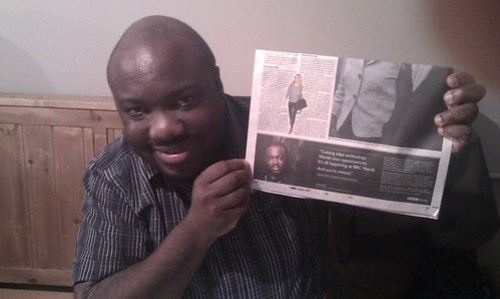
Yes I just about survived the embarrassment of being the face of BBC North’s recruitment event earlier this week. BBC North have stepped it up and are about to launch a series of adverts in the Guardian next week. So I’m preparing myself for people twittering and pinging me saying, hey I saw Ian in the Guardian today…
Oh and Happy Birthday to me… This weekend is my 30th Birthday Redux.

Me in the Guardian today (11/4/2011), look for the Media Guardian pull out section.
I do work for the most excellent BBC R&D and for the longest time, this was the home of BBC R&D, kingswood warren. When the BBC decided to shut it down and move all the researchers, engineers, etc elsewhere there was a massive backlash. I do understand why, I mean this was not just a location for R&D but also the spiritual home of R&D. Freeview, FreeviewHD, Freesat, Canvas (now youview), Dirac, BBC Redux, DAB, etc, etc came from here.
However things had to change… The notion of a R&D lab stuck over a hour away from the rest of the BBC in the middle of a super prime plot of land was never going to fly in 2010. I can’t tell you the amount of times I lost the way to Kingswood Warren!
Sort of emblematic Kingswood was of the shift in R&D as a whole towards much more public engagement I feel.
Categories
- aggregator (9)
- culture-and-politics (187)
- design-and-ideas (214)
- home entertainment (10)
- italic+mixing (77)
- just-plain-life (209)
- media-and-expression (284)
- italic+mixing (5)
- play-and-games (29)
- science+theory (27)
- social-hardware (254)
- socialware-offline (17)
- socialware-online (187)
- socialware-offline (225)
- technology (440)
- home entertainment (7)
- mobile-technology (198)
- technology-and-computing (146)
- xml and web 2.0 (318)
- data-and-semantic-web (104)
Recent Posts
- Ubuntu on Android
- A quick letter of complaint to Fevermedia
- Is it possible to match people with science?
- A year of making love and where it went wrong
- A year of making love?
- Missed my chance to have a wider debate on who pays first?
- Teaching the next generation with Povray?
- TedXManchester2: The Story of Me
- Don’t waste your life, living someone else’s life
- Watch the live stream of TEDxManchester2
- I’m signed up for who knows what…
- Bring your own bucket of photos
- Very early stage thinking around Perceptive Media
- Pipeling our reality
- Teresa Valdez Klein – The Art of Subvertising on Facebook
- Working from the Northern Quarter
- Ignite Leeds: Who pays on the first date?
- We’re either riding or queuing
- 1 concept 2 films…
- Should I apply for a BBC Three dating experiment?
What I'm Doing...
- Have this thought all the time? A Responsible Citizen Not Only Shares Culture, But Destroys The Copyright Industries http://t.co/r3AVICyj 8 hrs ago
- Chris (New Zealand)'s review of Alone Together: Why We Expect More from Technology and Less from Each Other via @imran http://t.co/fAoXLPGs 8 hrs ago
- Watch Ubuntu for Android in Action http://t.co/YITTKlkp 8 hrs ago
- Over heard... "what's that movie where Arnold Schwarzenegger is running around?" Ummm runningman darling? :) 20 hrs ago
- Cocktails on a Tuesday night... in @SimpleNQ for @Rosielou85's birthday... yeh! http://t.co/1qaVesDR 21 hrs ago
- More updates...
Archives
Recent Comments
- Ian Forrester on A year of making love and where it went wrong
- technicalfault on A year of making love and where it went wrong
- technicalfault on A quick letter of complaint to Fevermedia
- Marek Isalski on A quick letter of complaint to Fevermedia
- A quick letter of complaint to Fevermedia | Cubicgarden.com on A year of making love and where it went wrong
- Cel on A year of making love and where it went wrong
- Ian Forrester on A year of making love and where it went wrong
- Geordygoych on A year of making love and where it went wrong
Tags
android apple backstage barcamp bbc bbcbackstage bittorrent blog blogging conference data dating dj drm ebook facebook flickr geek geekdinner google internet iphone kindle linux london londongeekdinner manchester microsoft mix mobile music orange pacemaker phone podcast rss science social trance tv ubuntu uk video werewolf xbmcLifestream
-
Published Ubuntu on Android.
-
Published A quick letter of complaint to Fevermedia.
-
Published Is it possible to match people with science?.
-
Published A year of making love?.
-
Published Teaching the next generation with Povray?.
-