
We have come a long long way…
Tag: pc
Changes due to #BlackLivesMatter
There is a lot happening around black lives matter and sometimes its worth celebrating some of small things as we move closer to a much more antiracist stance (don’t get me wrong I know its a long long way off, but hearing some news it feels closer than ever)
BLM supporter speaks out after carrying counter-protester to safety
When I saw the picture on twitter I was blown away, I read the story and then found the channel4 interview.
Reddit’s co-founder resigns, asks to be replaced by black candidate
This happened quite soon after the first set of protests and I was surprised. Reddit has had its problems in the past and this could be actually a genius move.
Removing slave and master from openZFS, GitHub abandons ‘master’ and ‘slave’ and theres been moves to remove terms like whitelist.
I remember the first time I learned to build a PC being faced with the IDE/UDMA bus with master and slave devices. It bugged me but just lived with it. Its about time it was changed because it can easily be called something else. Its only legacy which has kept it as it is.

A number of movies and TV shows have faced up to their bias and racist prejudice. This of course has upset people but they will likely return with a content warning.
List of companies supporting black lives matter (at least on social media channels)
A nice list with a archive which will be very useful to look back in 6, 12, 18, 36 months time.
A friend (thatgirlvim) shared with me this fundraiser for a research study into Diverse & Equal Black Tech
Finally another good friend floated this lecture series to me recently. Modernity + Coloniality A free online summer course on coloniality and decoloniality. Looks really good but I’m not so keen on the open zoom, after my experience of zoombombing.
Samsung Galaxy Tab 3 or 7+

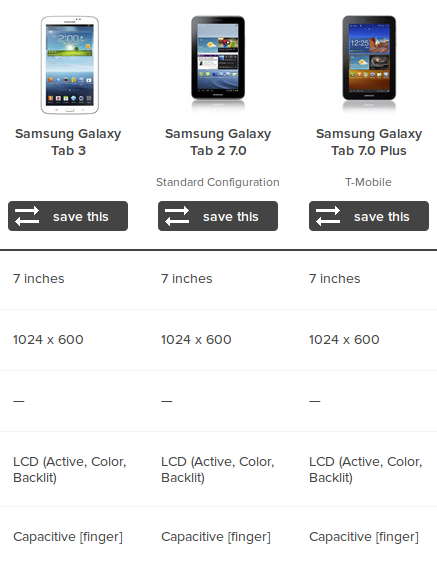
There is something funny going on with Samsung Tablets… I swear the 7inch Galaxy tab line up is almost exactly the same every year… Actually the only thing which seems to change is the operating system?
The new Galaxy Tab 3 has the exact same specs and screen resolution as the Galaxy Tab 2, and that is very similar to my own Galaxy Tab 7+
I’m sure my Galaxy 7+ running CyanogenMod 10.1 is the same as the Galaxy tab 3.
Some things Cory Doctorow said recently

Cory Doctorow’s agreements are usually pretty powerful but recently these two have had me reaching for the sky…
The Coming War on General Computation (the video is well worth watching… along with the transcript)
Techdirt breaks it down…
So today we have marketing departments who say things like “we don’t need computers, we need… appliances. Make me a computer that doesn’t run every program, just a program that does this specialized task, like streaming audio, or routing packets, or playing Xbox games, and make sure it doesn’t run programs that I haven’t authorized that might undermine our profits”. And on the surface, this seems like a reasonable idea — just a program that does one specialized task — after all, we can put an electric motor in a blender, and we can install a motor in a dishwasher, and we don’t worry if it’s still possible to run a dishwashing program in a blender. But that’s not what we do when we turn a computer into an appliance. We’re not making a computer that runs only the “appliance” app; we’re making a computer that can run every program, but which uses some combination of rootkits, spyware, and code-signing to prevent the user from knowing which processes are running, from installing her own software, and from terminating processes that she doesn’t want. In other words, an appliance is not a stripped-down computer — it is a fully functional computer with spyware on it out of the box.
Cory on “User uploads to YouTube hit one hour per second” (worth reading the whole thing)
A common tactic in discussions about the Internet as a free speech medium is to discount Internet discourse as inherently trivial. Who cares about cute pictures of kittens, inarticulate YouTube trolling, and blog posts about what you had for lunch or what your toddler said on the way to day-care? Do we really want to trade all the pleasure and economic activity generated by the entertainment industry for *that*? The usual rebuttal is to point out all the “worthy” ways that we communicate online: the scholarly discussions, the terminally ill comforting one another, the distance education that lifts poor and excluded people out of their limited straits, the dissidents who post videos of secret police murdering street protesters.
All that stuff is important, but when it comes to interpersonal communications, trivial should be enough.
The reason nearly everything we put on the Internet seems “trivial” is because, seen in isolation, nearly everything we say and do is also trivial. There is nothing of particular moment in the conversations I have with my wife over the breakfast table. There is nothing earthshaking in the stories I tell my daughter when we walk to daycare in the morning. This doesn’t mean that it’s sane, right, or even possible to regulate them
And yet, taken together, the collection of all these “meaningless” interactions comprise nearly the whole of our lives together. They are the invisible threads that bind us together as a family. When I am away from my family, it’s this that I miss. Our social intercourse is built on subtext as much as it is on text. When you ask your wife how she slept last night, you aren’t really interested in her sleep. You’re interested in her knowing that you care about her. When you ask after a friend’s kids, you don’t care about their potty-training progress — you and your friend are reinforcing your bond of mutual care.
If that’s not enough reason to defend the trivial, consider this: the momentous only arises from the trivial. When we rally around a friend with cancer, or celebrate the extraordinary achievements of a friend who does well, or commiserate over the death of a loved one, we do so only because we have an underlying layer of trivial interaction that makes it meaningful. Weddings are a big deal, but every wedding is preceded by a long period of small, individually unimportant interactions, and is also followed by them. But without these “unimportant” moments, there would be no marriages.
Android on your laptop

Iris Todorovic showed me her netbook and I was interested in the fact it had Android on it along side Ubuntu. It was Android Donut (or 1.6) so a very early version of Android, plus it was a Intel ATOM CPU. So I got thinking surely someones ported Android to a x86 / AMD64 processor architecture and made it work on a standard PC?
And I wasn’t wrong…
This is a project to port Android open source project to x86 platform, formerly known as “patch hosting for android x86 support“. The original plan is to host different patches for android x86 support from open source community. A few months after we created the project, we found out that we could do much more than just hosting patches. So we decide to create our code base to provide support on different x86 platforms, and set up a git server to host it.
Excellent, I’ll be giving it a try…
It takes 2 four year olds to show how silly our pc vs mac fighting can get…
Little asian PC girl vs. MAC parody – watch more funny videos
yep sometimes we act like 4 year olds….
Switching to Linux again…
Tim O'Reilly is on the money, there's trouble in Apple land. Jason Kottke and Cory Doctorow have made the switch to the Linux flavor Ubuntu for there operating system. This follows Mark Pilgrim and there seems to be more leading lights switching too.
Sarah really hates it when I say about switching to Linux, because she knows how outraged I get about some of the most simple things. But this really makes me want to switch even quicker. I've almost pledged never to run Windows Vista on my desktop or laptop machine. I'm not going to switch to OSX because I simply love the PC architecture and freedom it brings (Although I was tempted with the dodgy copies of running OSX on a AMD PC). So I'm going to move to Linux again. This time, I'm going to take it seriously and give it time. I already had OpenSuse 10.1 with XGL running on a spare machine. But now I'm talking about slowly switching everything including my Laptop.
I have already got a small list of some problems I'll have, such as my mobile phone which runnings on Windows Mobile 2005. My PIM syncing using Plaxo, and Hardware support such as my new Camcorder and weird motherboard. But with a year to get it all going, I'm sure to come up with the answers or another way to the same thing.
Ubuntu looks the way to go, specially if I can get xgl running too.